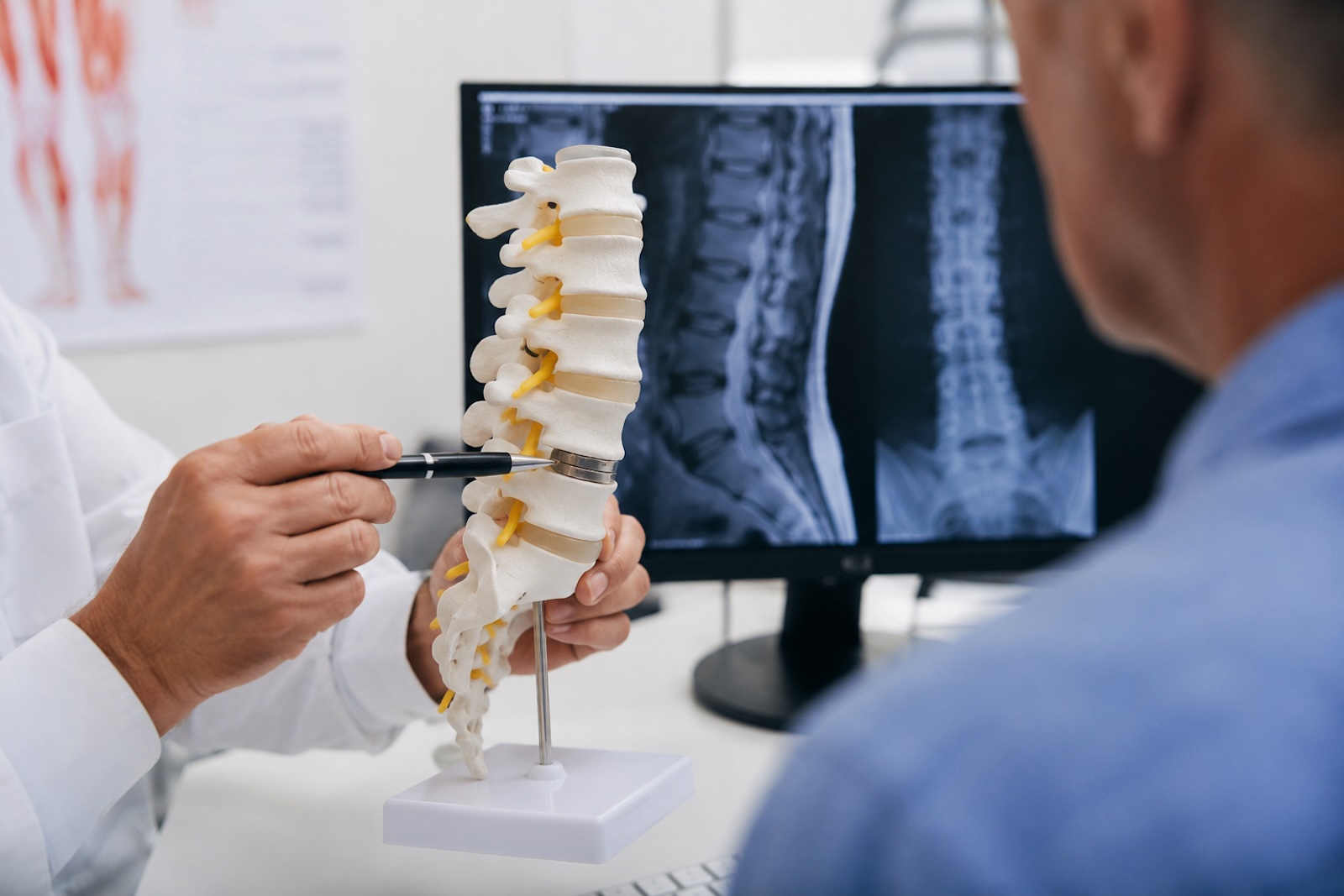
When patients begin researching artificial disc replacement (ADR), most of the focus is on the spinal disc itself, but the disc is only one part of a highly coordinated system.
The facet joints, small joints located at the back of the spine, play a critical role in guiding and stabilizing movement. If these joints are already damaged or arthritic, preserving motion through ADR may not always be the best solution.
At ADR Spine, Dr. Todd H. Lanman evaluates not just the disc but the full biomechanics of the spine to determine whether motion preservation will truly improve a patient’s outcome. In this article, we explain what facet arthritis is, why it may impact your candidacy for ADR, and how an expert opinion can help clarify your path forward.
Facet joints connect each vertebra and help control how the spine moves, particularly when it comes to bending, twisting, and extension.
Over time, these joints can develop arthritis due to:
When facet arthritis develops, the cartilage within the joint breaks down, leading to inflammation, stiffness, and pain.
Even if a spinal disc is damaged, the surrounding joints must still be healthy enough to tolerate motion. Otherwise, preserving movement may continue to stress an already painful joint.
Artificial disc replacement is designed to preserve motion, unlike spinal fusion, which eliminates it. This is a critical distinction as, if the facet joints are already significantly arthritic:
In contrast, spinal fusion limits motion at the affected level, which can sometimes reduce pain coming from severely degenerated facet joints.
This is why ADR is not simply about replacing a disc; it’s about selecting the right patients whose entire spinal segment can benefit from continued movement.
The short answer: sometimes, but not always.
Facet arthritis exists on a spectrum.
Candidacy depends on several factors:
An experienced spine surgeon like Dr. Lanman will evaluate your spinal health comprehensively, looking at all of these elements together, not in isolation.
When you meet with a spine expert, they will ask you about certain specific symptoms that can help to determine if facet joints are contributing to your pain. These may include:
While these symptoms can help your surgeon determine your eligibility for ADR, they’re not enough individually to determine next steps.
Determining whether pain is coming from the disc, the facet joints, or both requires a comprehensive workup. At ADR Spine, this typically includes:
In some cases, diagnostic injections may also be used to isolate the source of pain.
Importantly, candidacy for ADR is never based on a single scan or finding; it is based on how all of these factors come together. This is why it’s so important to work with an experienced, skilled doctor.
Being ruled out for artificial disc replacement does not mean you are out of options. Your surgeon will work with you to determine the best possible path forward for you and, depending on your condition, alternatives may include:
While fusion eliminates motion at one level, it can be the more appropriate solution when facet joint degeneration is advanced. Learn more about ADR vs spinal fusion here.
One of the most important principles in spine care is that the best procedure is the one that matches the true source of pain.
If the disc is the primary issue, ADR may offer meaningful relief while preserving mobility. But if the facet joints are the dominant pain generator, disc replacement alone may not address the problem, and could even prolong it.
This is why a precise diagnosis is more valuable than pursuing any single surgical option. ADR Spine surgeons are familiar with a broad range of multilevel and complex cases and can help to determine the next steps for your unique case.
A thorough second opinion can help clarify whether motion preservation is appropriate or whether another approach may better align with your condition. It may be worth seeking an evaluation if you have been told:
At ADR Spine, Dr. Todd H. Lanman brings over 30 years of experience in motion-preserving spine surgery, including serving as a lead investigator in clinical trials for artificial disc devices.
Every evaluation is grounded in a comprehensive understanding of spinal mechanics considering not just the disc, but the facet joints, alignment, and overall function of the spine.
If you are exploring your options, schedule a consultation and take the next step to a clear, expert-guided diagnosis with one of our Top Doctors in Arthroplasty.
FOLLOW US ON SOCIAL MEDIA | @ADRSPINE